
Ok, so you improvise. Maybe over changes, maybe free, maybe it is just you at home in the evening with nobody listening. Then you know the moment when the tune stops and now it is only you and whatever you can find.
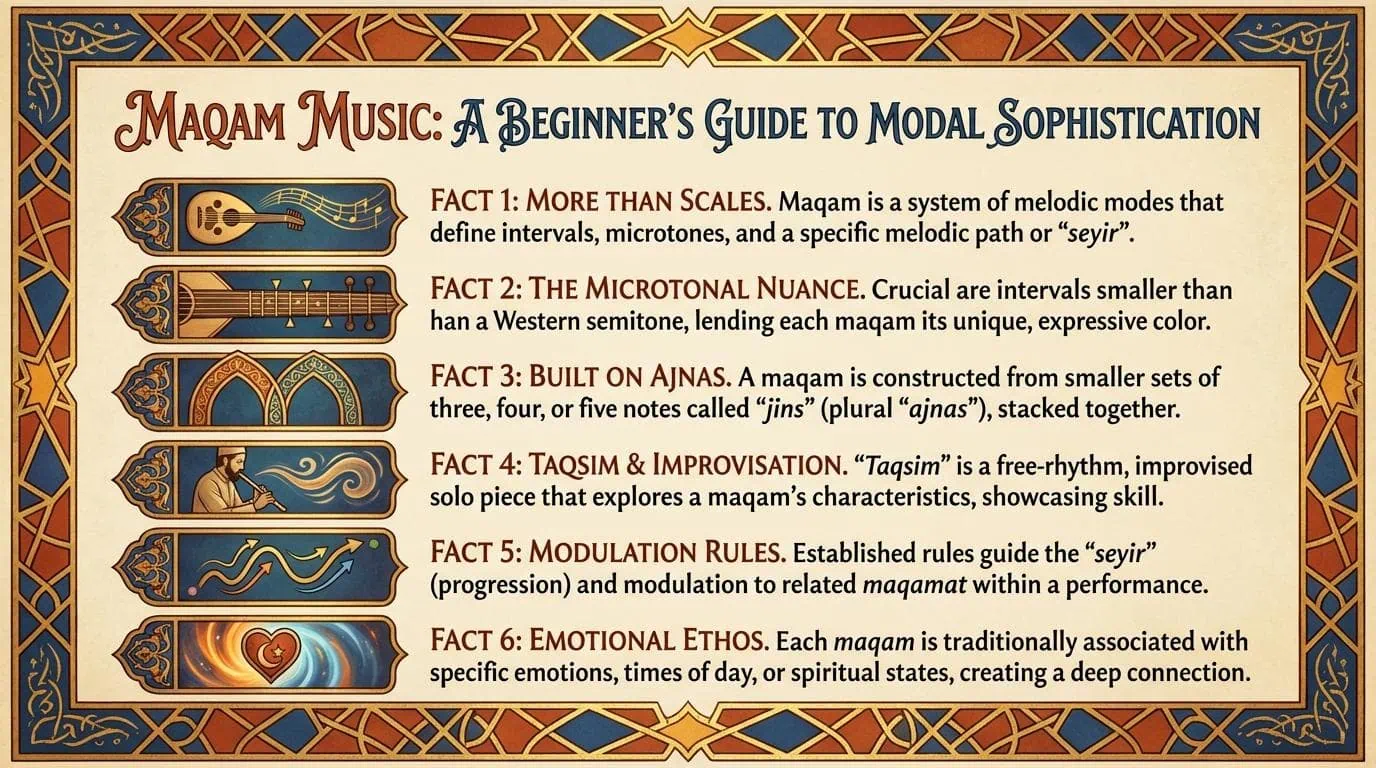
I want to show you how this is done in Arabic and Turkish music. It is called taqsim. It is a solo improvisation with no rhythm, no chord changes, and no fixed length, and it can be one minute or it can be fifteen. I make and sell ouds for a living, so I hear a lot of them, good ones and bad ones.
The difference from a jazz solo is that there is nothing under you. In a jazz solo you have the changes, and you have a meter holding the room together. In a taqsim you have no chords and usually no pulse at all. You take one maqam, and you walk around inside it, and the maqam is stricter than you expect and more free than you expect, both at the same time.
A maqam is not a scale
This is the first thing, and most of the internet gets it wrong. A maqam is not a scale that you run up and down.
It is built from small pieces. Each piece is called a jins, three or four or five notes, and each jins has its own character. You build a maqam by putting one jins on top of another.
Take maqam Rast, it is the main one in Arabic music. It starts with jins Rast on C, that is C, D, E half-flat, F. Then on the fifth degree you put either jins Rast again, or you put jins Nahawand, which is the minor sounding one. Same first four notes, two different maqamat, and you did not change anything in the beginning.
The other ajnas have their own faces. Bayati has a neutral second and it is the sound of most Arabic folk music you ever heard. Hijaz has the big step in the bottom, the one everybody recognises and everybody overuses. Saba has a lowered fourth degree, G flat if you start it on D, and because of that the octave does not come out clean. You cannot put a chord under Saba without breaking it. That is the one people call the sad one, and now you know it is not only a feeling, it is in the intervals.
The note that is not on your piano
E half-flat. That is the note you have to understand to practice taqsim.
It is not E flat and it is not E. It sits between them. In Arabic theory the octave is divided into 24 quarter tones, so E half-flat lands 350 cents above the C. E flat is 300, E natural is 400. Exactly in the middle, and this is the note that makes Rast sound like Rast.
Turkish theory does not count quarter tones at all. It counts commas, 53 in the octave, about 22.64 cents each. So the same note comes out at 15 commas, around 339.6 cents, or at 16 commas, around 362.2 cents, depends which table you read and who taught you.
So Arabic and Turkish music do not even agree where the note is. And inside Arabic music it moves also. A player in Aleppo puts it a little higher, a player in Cairo a little lower, ten cents, twenty cents, and both of them are right. It moves inside one phrase too, going up it comes a bit sharper, coming down into a cadence it comes a bit flatter. Nobody writes this in a book. You get it from listening.
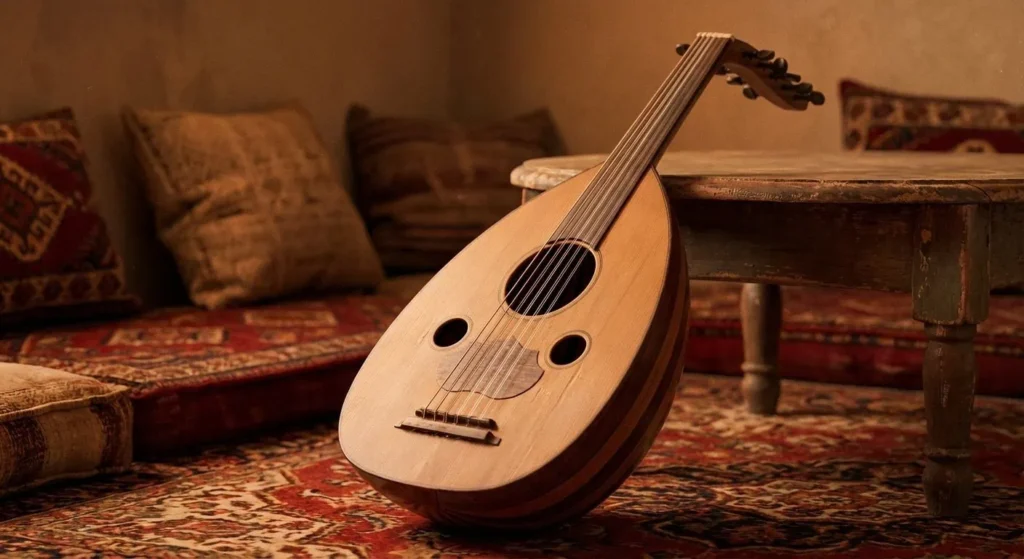
This is why the oud has no frets. Not for the romance of it. The note is not in a fixed place, so you cannot put a piece of gut across the neck and decide it for the player.
And if you go and search for “arabic scale” you will find pages telling you it is the Locrian mode, or some scale with an augmented fourth and an augmented fifth in it. Forget all of it. That is a guitar thing from the eighties and it has nothing to do with Arabic music.
The man in Oran who played Taqsim on a piano anyway
Now if you play piano you see your problem already. The note is not on your instrument. It is not there, you cannot reach it, and the piano is not going to bend for you.
So let me tell you about Maurice El Médioni. He was born in 1928 in the Derb, the Jewish quarter of Oran in Algeria, and he died in 2024, ninety five years old.
An Old Piano
He was nine when his older brother came back from the flea market with an old piano. “It was the happiest day of my life,” he said about it later. Nobody taught him to play it. “I learned in a week. There was an absolute relationship between my fingers and my brain.” Everybody assumes the music came from his uncle, because his uncle was Saoud l’Oranais, a big name in Oran with a cafe where he played violin and sang. Maurice said no, it did not come to him through the uncle.
It came from the street. He was playing at the Cafe Salvat, three North African street musicians passed by with a derbouka and a tambourine, and in the evening they were playing together. Then the war came and the American soldiers came with it, Puerto Ricans and Dominicans, and they brought Cuban rumba into the clubs of Oran and boogie woogie with it. He put all of it into the same two hands and he called it pianoriental.
Taqsim Tones Translated
Now, what he did with the maqam is the part for you. First, he took the quarter tone of the oud and he moved it onto a keyboard that does not have it. This is something he never explained as a technique. Médioni said he was mixing the “spirit” of the quarter tone with the Cuban rumba and the boogie woogie. (Spirit is his word, not mine.) The New York Times, when he died, wrote about his bounding octaves and his quasi microtonal shifts. That means fast trills, two neighbour notes rolled together and held under the pedal, octaves jumping. The E half-flat is still not there. He plays around the hole where it should be and the ear of the listener puts it in.
I will be honest with you, this is not a solution and it is not trivial. The note is still missing. But he made the piano say something close enough that people in Oran loved him for sixty years, Jews and Muslims both. He wrote the whole story himself in a memoir, From Oran to Marseilles, and it is worth your time.
Sayr, the path
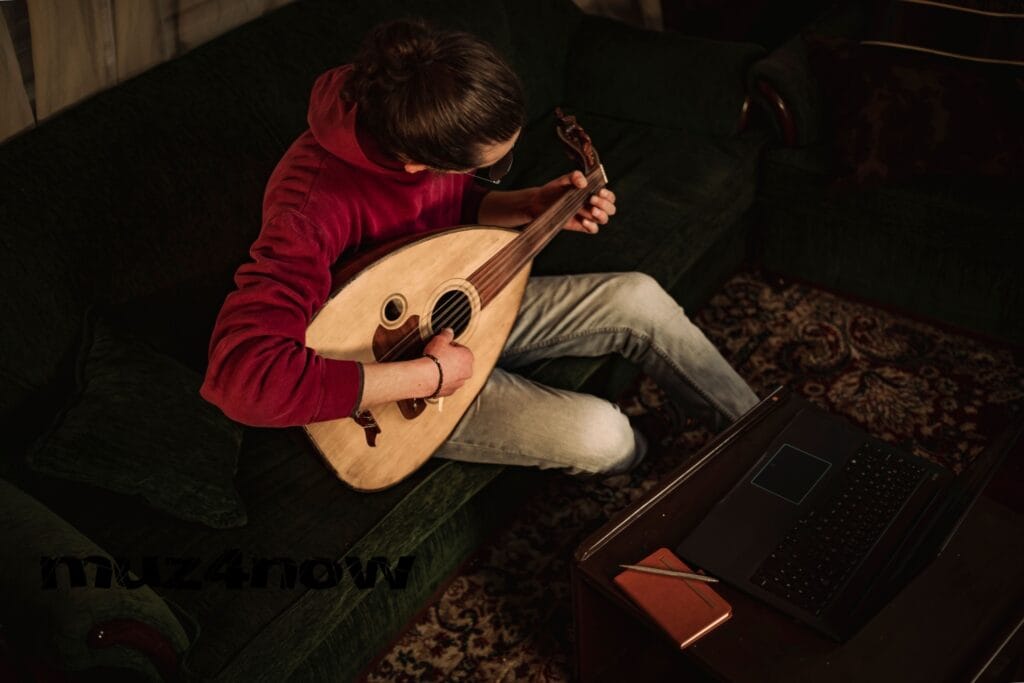
Ok. So now you have the notes. That is still not a taqsim, not even close.
Every maqam has a sayr. It means the path, or the course. Where you start, which note you lean on, when you are allowed to climb, where you can leave to another maqam, and how you come home. It is not written anywhere as a rule. It is the behaviour of the maqam, and you learn it from hearing hundreds of taqsim until it is inside you.
In Rast you start low, near the tonic, and you stay in the first jins a while so the listener knows where he is. Then you go up to the ghammaz, that is the note where the maqam pivots, and you sit on it and you keep coming back to it. From there you can leave, to Nahawand on the G, or to Bayati, or to Hijaz. Then you come back down and you finish on the tonic, and everybody in the room knows it is finished, and no chord did that, it is the path that tells them.
This is the part people miss. Two maqamat can have almost the same notes and still be two different maqamat, because the sayr goes through them differently. So a taqsim is not free the way people say it is free. The path is already there and you learned it from the players before you, and what is yours is what you do inside it.
How to hear it, and how to try it
Put on Munir Bashir. He was Iraqi, he is about as far as the oud goes, and he will stay in one maqam for ten minutes and take all the time he wants. This one is a taqsim in Rast, so it is the same maqam you just read about, and that E half-flat you cannot play at home is sitting right there in the first phrase. Do not analyse it the first time. Just follow the line and hear how long he waits before he goes up.
Listen to other taqsim players. Then, if your instrument can bend, a fretless bass, a violin, your voice, try one maqam.
Take Rast. Find the tonic, play the first four notes, and look for that E half-flat with your ear and not with a tuner. Sit on it and hold it. It will feel wrong for a while, that is normal, keep going.
And if you are sitting at a piano, then you are in Oran in 1950 and you know already what your job is. Play around the note, and let the ear of the listener do the rest.
One more thing, and it is the thing most beginners get wrong. They fill every second. Play three notes and stop, and listen to the silence after them. The listener needs that silence, he is still catching up with what you played, and you are still deciding what comes next. It takes years, and it is honest to say it.
Daniel is a multi-instrumentalist and lifelong oud player who knows Arabic and Turkish instruments inside out. He founded Ethnic Musical and has worked with luthiers across Turkey, Armenia and beyond since 2009, building fine handmade Turkish and Arabic instruments.
The main (top) blog photo is by abedalbaset and obtained via Pexels.
Discover more from Stan Stewart - @muz4now
Subscribe to get the latest posts sent to your email.
Pyano playing is great well shared